
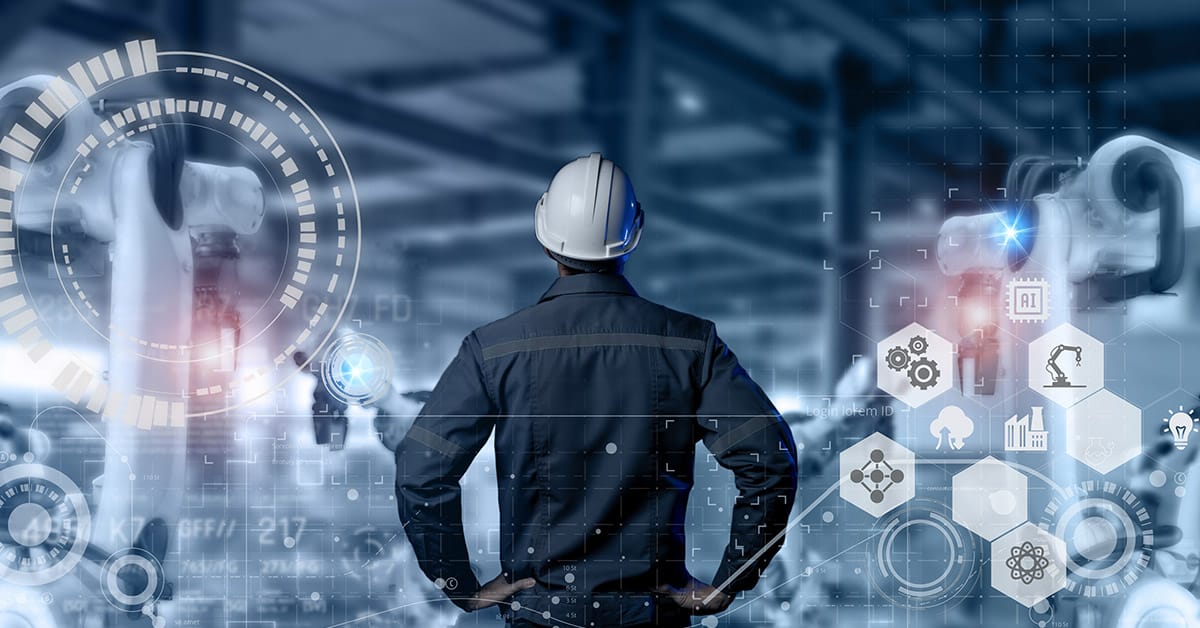




Artificial intelligence, as part of Industry 4.0, is increasingly commonplace in manufacturing, with one subset in particular gaining a strong foothold: machine learning (ML). This is a capability often integrated with generative AI, where systems use machine learning to automatically improve based on the data they receive, essentially “learning” from it. As manufacturers look for more innovative ways to increase stability, resiliency, responsiveness and, as always, efficiency and profit margins, machine learning and manufacturing are proving to be a natural fit. Many are using it to drive predictive insights, enable process automation and improve their maintenance programs.
In this article, we will learn what machine learning for manufacturing entails, how it is used in manufacturing settings and what the primary benefits of this technology are. The influence of machine learning can be seen at every level of the manufacturing sector, from design and production to maintenance and sustainability.
What is machine learning in manufacturing?
Machine learning is a subset of artificial intelligence that draws upon data inputs—at an enormous scale—to provide insights, make decisions and essentially “think” in a manner informed by human thought processes. This means it’s almost like having a virtual technician who is constantly learning from sensor data to predict issues before they occur. Machine learning output can have a significant positive effect on maintenance efficiency, quality checks, product development and more.
Applications of machine learning in manufacturing
Machine learning has numerous applications throughout manufacturing, including:
Predictive Maintenance
Predictive maintenance as a practice is built upon data collection and monitoring and gets more effective as more data is introduced. This makes it a perfect fit for machine learning, which can provide unprecedented advances and benefits in a predictive maintenance approach.
Predictive maintenance works by identifying potential failure signifiers as soon as they occur—long before they lead to potential equipment breakdowns—and flagging them for maintenance technicians to investigate and remedy as needed, at a convenient time. With machine learning, maintenance can become even more efficient and effective. Machine learning can identify potential issues, suggest solutions and help schedule an optimal time to troubleshoot and resolve the scenario. Furthermore, as a “neural network” or deep learning in manufacturing application, machine learning algorithms can analyze data to identify new potential failure states, adding them to the list of potential alerts.
Digital twins
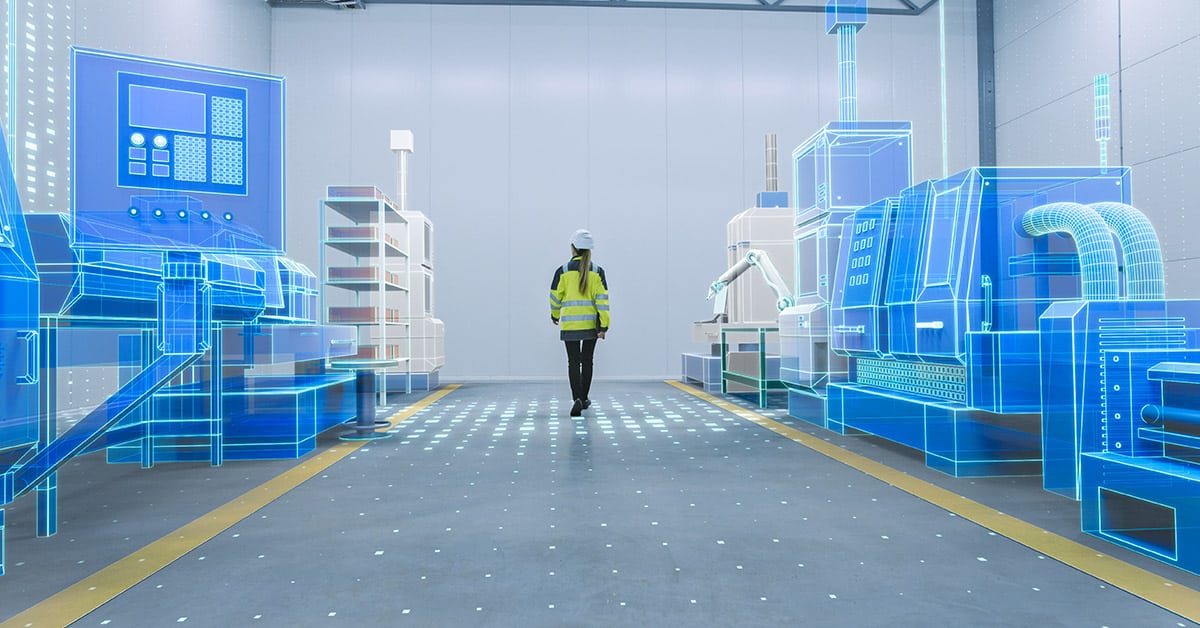
Digital twins in manufacturing refer to virtual replicas of equipment, components or designs, which can be rendered in real-time 3D and “handled” in a way that mimics interaction with the part itself. Digital twins help with maintenance, training, collaboration, product design and more. By introducing machine learning technology into digital twin use cases, manufacturers can see additional benefits in production efficiency, time-to-market and innovation.
With machine learning, digital twin technology can enable design optimization, faster product development, improved product quality, more accurate design and prototyping, and more. ML algorithms in this context can also be used to develop the most efficient production methods possible, further reducing costs and reducing time to market.
Predictive quality assurance & yields
Machine learning for manufacturing process optimization extends to the quality assurance stage of production. As the last line of defense against faulty products making it into customers’ hands, quality control is a critical part of any manufacturing operation. With machine learning technology, manufacturers can reduce or even eliminate product loss due to production errors by applying machine learning to root cause analysis (RCA).
Root cause analysis draws upon production and inspection data to identify process errors and inefficiencies that are likely to lead to discarded product and can then make recommendations and adjustments to processes in order to remedy these scenarios. With machine learning, this process occurs quickly and constantly, with the ability to provide real-time reporting and insight into production statuses. This helps to prevent errors from occurring at a large scale throughout a production run, since machine learning can provide alerts to shut down the production line if a batch or run is in danger of being lost.
Supply chain optimization
Machine learning in the supply chain is helping manufacturers overcome the challenges of global economic uncertainty. From price fluctuations to demand increases to material shortages, effective supply chain management is often more difficult than ever—which can drive costs and prices up, threaten relationships with suppliers and customers, and wreak havoc on production schedules. By introducing machine learning-powered “smart supply chain” tactics, manufacturers can make great strides in addressing these problems head-on.
For the supply chain, ML models can be effective in warehouse management, demand analysis, ordering, demand forecasting, supplier management and selection, logistics, route optimization and more. Machine learning is able to take a vast amount of real-time input—demand, inventory, production status, supplier status, weather, global macroeconomic trends and more—and synthesize it to make fast, effective decisions that can make the difference between a made or missed deadline, or a project that comes in above or below budget.
Product design
Product designers and engineers are seeing vast benefits from machine learning, with the technology helping from almost the very first step in developing new product concepts. Machine learning is able to take customer research, feedback and usage information as inputs, and use it to create data-backed proposals for new products. Machine learning can help with design iteration, compatibility testing (via digital twin technology), design for manufacture and more. By incorporating machine learning into the end-to-end product lifecycle, manufacturers can see unprecedented efficiency and cost benefits at every stage of development and production.
Green manufacturing process
Green manufacturing and sustainability are increasingly important considerations for manufacturers, and machine learning can be incredibly helpful in meeting these goals. ML can predict and optimize energy consumption, and—with the right infrastructure—can directly manage energy usage to reflect the needs of people and equipment. For example, machine learning can control lighting and temperature and can also be used to create efficiencies in raw material usage and reclamation.

Manufacturing data analysis with machine learning
One of the most impactful benefits of ML in manufacturing is the opportunity to take a deep dive into data. The machine learning process involves a considerable amount of data collection. This means manufacturers can have a wealth of information to draw from as they make decisions. They are provided with all the details they need to make the most informed choices regarding performing machine maintenance, reducing downtime and helping to control costs. As part of our industrial technology services, ATS provides a predictive analytics dashboard where actionable insights are delivered directly to our customer’s.
Benefits of machine learning in manufacturing
With the above applications in mind, we can now look at the direct benefits that machine learning provides for manufacturers. These benefits include:
- Production process optimization — Machine learning can help reduce waste and improve the overall quality of the finished product.
- Enhanced employee safety — With equipment properly maintained, employees are less at risk for injuries caused by malfunctions.
- Improved production costs — Manufacturers can save money thanks to fewer work stoppages and lower utility bills as they keep their equipment in good working order.
- Better supply chain management — Machine learning can better predict spikes in demand so manufacturers can maintain proper inventory levels.
- Scalability — Manufacturers can scale production up or down in anticipation of changes in demand much more easily with machine learning integrated into their processes.
- More efficient inventory management — With a wealth of information about their operations, manufacturers can manage their inventories as efficiently as possible.
Machine learning and human expertise
Despite what many people believe, machine learning isn’t intended to replace human expertise in factories. Instead, it enhances it by providing detailed analytics and insights that would take a technician hours of pouring over datasets to compile. Based on the findings generated by machine learning systems, technicians can interpret data, validate predictions and take corrective actions, all in a fraction of the time it would have taken them before.
Implementing machine learning in your operations
Now that you understand machine learning and its applications for manufacturers, you are ready to start thinking about its application in your own organization. Machine learning can often build upon existing automation technology but will also almost always require additional investment in data sensors, analytics tools, communications tools and more. By understanding the big-picture benefits and use cases, you are well-equipped to make an informed decision about how to implement the right set of tools for you and your operational goals.
As the recognized leaders in industrial maintenance services, ATS has the expertise and knowledge needed to help you take the next step toward leveraging machine learning. We provide reliability assessments that evaluate your readiness for predictive analytics, and can start pilot projects to help you get your feet wet before scaling up to your entire operation. Contact ATS to help you on your journey of technology-driven industrial maintenance to increase uptime, reduce costs and achieve lasting operational excellence.